
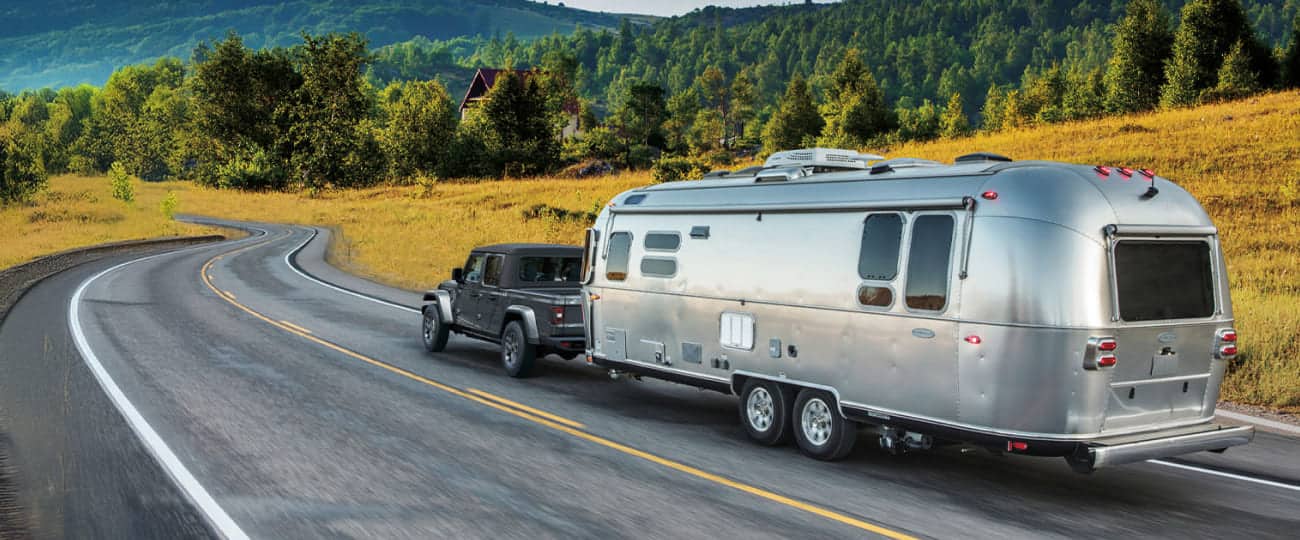
BUILT FOR BIG HAULS

The Jeep® Brand has always been synonymous with incredible capability and utility, and towing is a big part of that. But seeing our logo alone isn’t enough—it’s important to know your towing capacity before hitching a trailer to your vehicle, so that you can tow safely and securely.

IMPORTANT TOWING TERMINOLOGY

When it comes to determining Jeep® Brand vehicle towing capacity or how much can a Jeep Brand vehicle tow, knowing the proper terms is especially important. Here’s a breakdown of commonly-used towing terms that you should know if you’re planning to tow. For more helpful terminology, Braked towing capacity is how much your vehicle can tow when your trailer includes brakes of its own, while unbraked towing capacity is how much your vehicle can tow when the trailer does not have its own brakes. A trailer with its own brakes allows for greater hauling than one that does not have its own brakes, so you should factor that into your calculations. Jeep® Gladiator shown with aluminum hood. Actual hood may vary.

HOW TO DETERMINE VEHICLE TOWING CAPACITY

To determine the vehicle’s towing capacity, subtract the vehicle’s curb weight and payload (including the weight of the driver, passengers, cargo and the tongue weight of the trailer) from its Gross Combined Weight Rating. The resulting number is your maximum towing capacity.

THE PARTS OF A JEEP® BRAND VEHICLE'S TOWING HOOKUP

It’s helpful to recognize the different parts of a trailer hitch on sight. Here, you can review the primary pieces of a Jeep® Brand vehicle’s towing hookup, so that you’re aware of what’s what when you’re down there attaching a trailer.

• Hitch

• Trailer Ball

• Ball Mount

• Trailer Coupler

• Hitch Pin

• Electrical Receiver

HITCH CLASSES

While most receiver hitches are built to be vehicle-specific, there are different classes of towing hitches required for different types of vehicles. Discover a few of the most commonly found hitch types below.

CLASS I

A Class I Trailer Hitch is used for small vehicles. It has a 1.25-inch receiver size and can tow up to 2,000 pounds.

Class II

A Class II Trailer Hitch is used for midsize vehicles such as CUVs and minivans. It has a 1.25-inch receiver size and can tow up to 3,500 pounds.

Class III

A Class III Trailer Hitch is used for SUV towing and other large vehicle towing. It has a 2-inch receiver size and can haul up to 8,000 pounds.

Class IV

A Class IV Trailer Hitch is generally found on pickup trucks and other large, utility-focused vehicles. It has a 2-inch receiver size and can tow up to 10,000 pounds.

SPECIALITY HITCHES AND ATTACHMENTS

Certain towing adventures require hitch and trailer types that have been engineered for specific purposes. Some other hitch types to consider when planning a big haul are:

•  Multi-Fit Hitch – Designed to fit as many different types of vehicles as possible while including a standard receiver and on-par weight capacity.

•  Cargo Hitch Attachment – Connects to a standard hitch receiver and contains a large cargo container for your oversized belongings and accessories.

•  Bike Rack Hitch Attachment – Also connects to a standard hitch receiver. Used to attach a bike rack to the rear of your vehicle.

•  RV Hitch – Specifically designed to help your truck tow a recreational vehicle.

Jeep® Gladiator shown with aluminum hood. Actual hood may vary.

TRAILER TOW PACKAGES

While Jeep® Brand vehicles are built with towing in mind, that doesn’t mean they all come ready to tow right out of the factory. For many Jeep Brand vehicles, Trailer Tow Packages are available and often necessary for serious towing projects. Speak to your dealer about which Trailer Tow packages are available for the vehicle you’re looking to lease or purchase.

OTHER IMPORTANT TOWING FEATURES AND HARDWARE

Towing what you need is still about attaching one piece of metal to the other. But specific capability stats and features can enhance and define your towing experience.

CHOOSE YOUR JEEP® BRAND VEHICLE

Now that you’re up to date on towing, pick a Jeep® Brand vehicle and start your next adventure.

CHOOSE YOUR JEEP® BRAND VEHICLE

Now that you’re up to date on towing, pick a Jeep® Brand vehicle and start your next adventure.

JEEP® BRAND TOWING FAQ

Every Jeep® Brand vehicle is capable of towing. Jeep Brand towing can be found on the Jeep Wrangler, the Jeep Gladiator, the Jeep Recon, the 2026 Jeep Cherokee, the Jeep Grand Cherokee, the Jeep Compass, the Jeep Grand Wagoneer and the Jeep Wagoneer S.

Determining a Jeep® Brand vehicle towing capacity involves factors like engine power, transmission and frame strength. Most crucial are the Gross Combined Weight Rating (GCWR), which is the weight of your vehicle and everything inside of it (including fluids, passengers and luggage) along with the weight of what you’re towing. To get the maximum weight of a trailer you can tow, just subtract the curb weight and payload from the GCWR.

Your towing capacity is the weight your vehicle can safely tow behind it. Your payload capacity is the maximum amount of weight your vehicle can safely carry, including all passengers and cargo within or on the vehicle. Simply put, payload is any additional weight you add to the vehicle post-factory delivery. And if you’re towing, payload can also include the tongue weight of a trailer.

Yes, adding passengers or cargo does reduce towing capacity. Adding more weight to your vehicle (with people or cargo) increases your payload. That will offset the maximum weight you can tow based on the Gross Combined Weight Rating (GCWR). A quick math lesson: 


Towing capacity = GCWR – the vehicle’s actual weight (curb weight + payload). 

For many Jeep® Brand vehicles, Trailer Tow packages are available and often necessary for serious towing projects. But each Jeep Brand vehicle’s Trailer Tow package includes different features to ensure that it can tow safely and capably. Contact your dealer about which Trailer Tow packages are available for the vehicle you’re looking to lease or purchase.

The safety towing features that help with towing a Jeep® Brand vehicle include the Electronic Stability Control System, which uses features like Trailer Sway Control to help make sure your trailer stays straight and stable behind you. The vehicle also houses an available 360° Surround View Camera, which allows you to view the exterior of your vehicle in all directions so you’re aware of your surroundings as you tow.

Drivers should check the maximum towing capacity of their Jeep® Brand vehicle to make sure it can handle the weight they are trying to tow. They should check the local laws on towing speeds and plan to drive a little slower — and with more distance between cars — than they normally might. They should also check what kind of trailer hitch they have and whether or not they need a specialized hitch like a cargo hitch, a bike rack hitch or an RV hitch. Finally, they should check their route and terrain to see whether or not they need to adjust their vehicle or their trailer in any way, in case they’ll be driving off-road or on narrow streets.

The amount of weight being towed by your Jeep® Brand vehicle and the terrain on which you’re taking it will affect your fuel economy. The more weight you’re towing, the harder your engine is working, and the more fuel it may consume, which will affect your towing gas mileage.

Many experts recommend driving no faster than 55 – 65 mph on the highway, no matter what the posted speed limit is, while towing. Some states even have lower speed limit laws for towing. Make sure you check before you hit the road. Experts also recommend leaving more distance between you and the vehicle ahead of you, which could be a 5-second gap. You should also pack and plan with current driving conditions in mind and review your Jeep Brand vehicle’s owner’s manual to help you feel confident and prepared on any adventure.

All factory-installed equipment on Jeep® Brand vehicles should be covered by your warranty. However, available and aftermarket equipment and accessories are not covered by your warranty.