
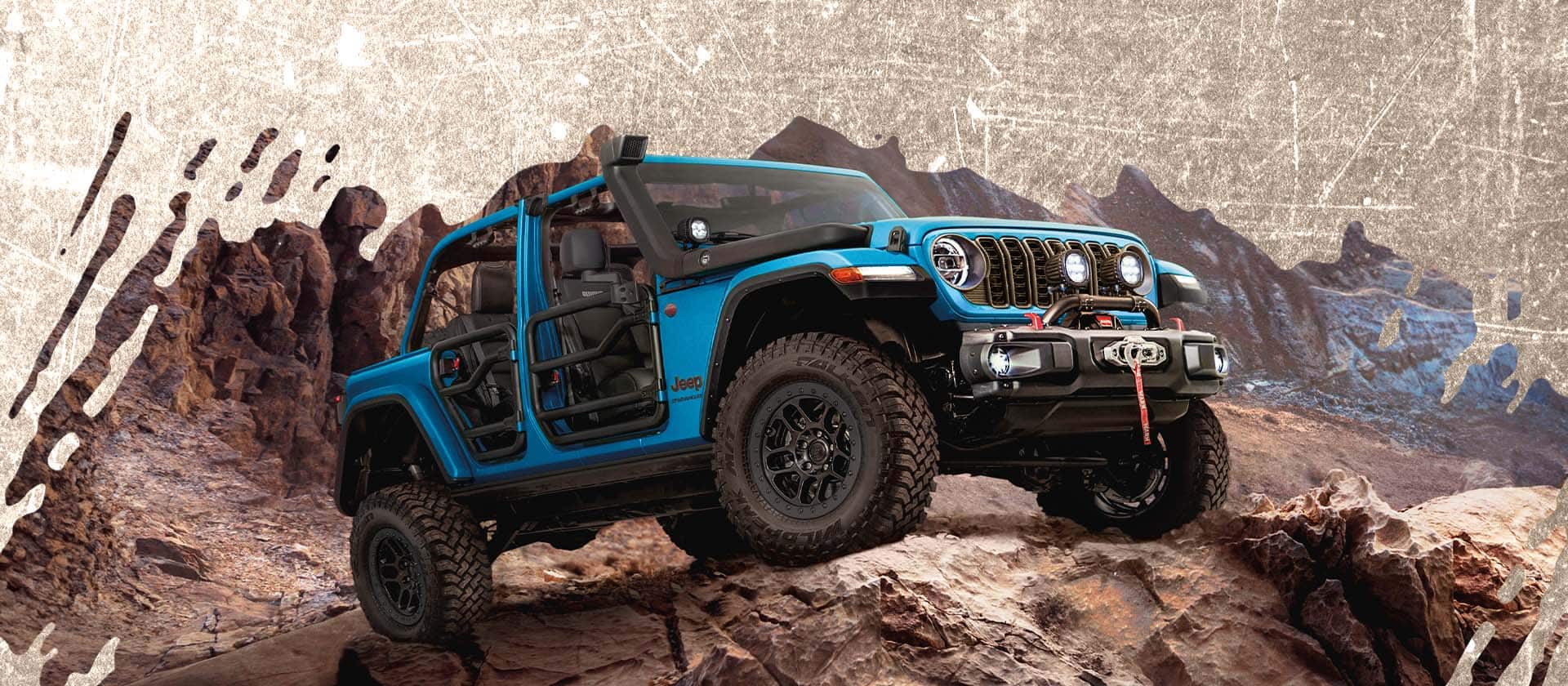
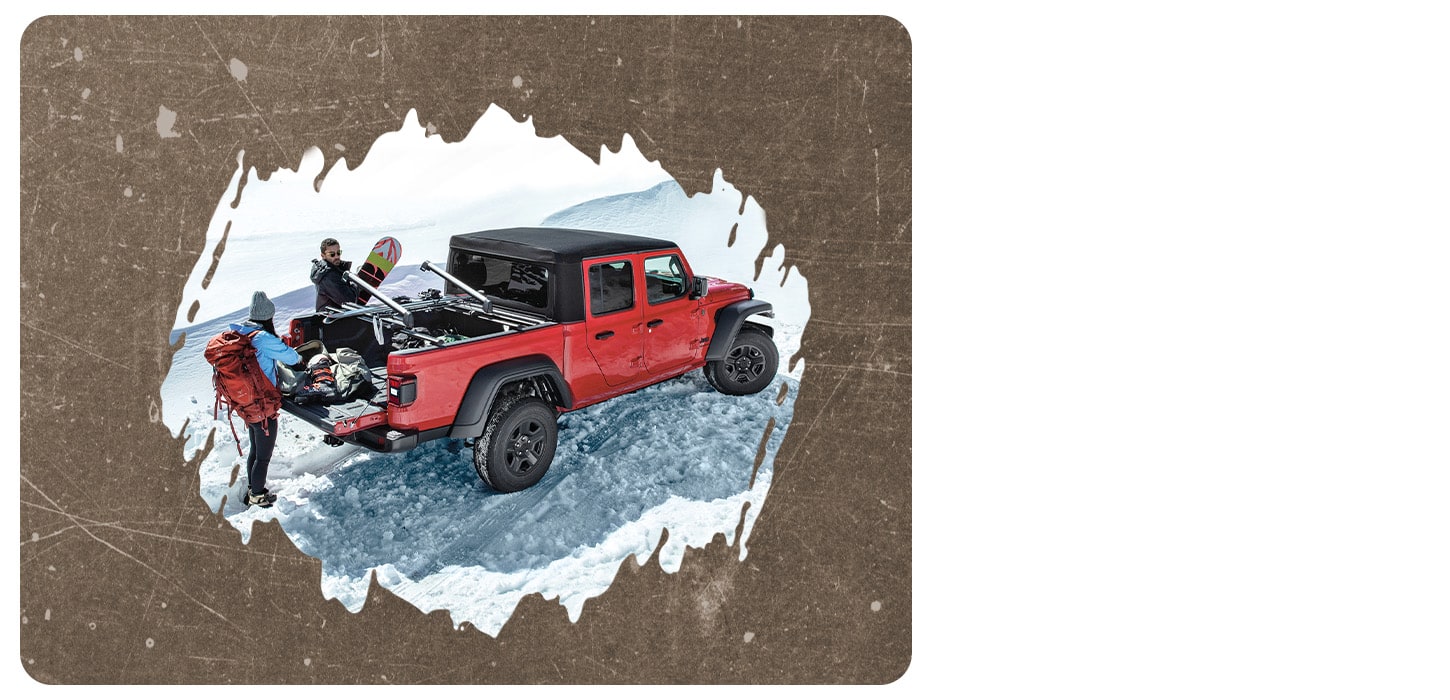
 Jeep® Wrangler shown with aftermarket accessories.

A Beginner’s Guide to Off-Roading Terms and Techniques
,A breakdown of off-roading for new and curious adventurers.
,All right, the cooler’s packed, you’ve got your bug spray on—time to get off-roading, right? Except wait, are you just off-roading, or are you mudding? What’s the approach angle of your SUV? Where are its recovery points?
,If none of this makes sense to you—or if you’ve heard these terms, but have no idea what they mean—you're not alone. Plenty of people think off-roading just means driving into the woods. But understanding the different types of off-roading helps you know what kind of trip you’re in for, and knowing the terminology of off-roading lets you better understand experts when they give you advice or instructions.
,Use this handy guide as your introduction to off-roading terms and techniques.
,
Off-Road Basics
,Let’s lock down the basics: off-roading is the sport or activity of driving a vehicle over rough, unpaved terrain. What type of terrain that is—a snowy mountain, a muddy swamp, the surface of Mars—is up to you.
,A few other things to note:
,Off-roading vehicles are also called “Off-Highway Vehicles.” Just in case you’re trying to find out more information and searching ‘off-road vehicles’ isn’t giving you what you need.
,Jeep® Brand off-roading vehicles are also called “4x4 vehicles,” but are sometimes referred to as “Four-Wheel Drive Vehicles” or “4WD Vehicles.” That’s the technical term for the off-roading vehicles that the Jeep® Brand produces.
,4x4 driving and AWD aren’t the same thing. 4x4 systems require driver engagement—they usually need to be “turned on”--and are preferable on rugged terrain. Full-time AWD is always active and sends power to all four wheels, which helps on slippery roads.
,There are other types of off-roading vehicles. Some other off-roading vehicles are snowmobiles, dirt bikes, all-terrain vehicles (ATVs) or recreational off-highway vehicles (like dune buggies).
,

Before We Begin, An Important Disclaimer
,While it’s a lot of fun, off-roading can be treacherous, even dangerous. Please off-road only on approved roads or trails and at your skill level. Don’t off-road alone—always do so with a partner or friend. Please take appropriate precautions to help ensure that you and anyone off-roading with you is safe and secure. This is supposed to be a good time for everyone.
,Now that we’ve gotten that out of the way...
,
Important Off-Roading Terms
,Here are a few terms to know when you’re taking things off the beaten path. Jeep® Wrangler shown with aluminum hood. Actual hood may vary.
,
Approach Angle
Departure Angle
Breakover Angle
Ground Clearance
,Ground clearance is the distance between the lowest point of your vehicle and the ground. Think of it this way: if you’re going straight, what can you drive over without it hitting the underside of your vehicle? Most 4x4 vehicles are built with solid ground clearance—for example, the 2026 Jeep® Grand Cherokee and 2026 Jeep Gladiator both have Best-in-Class available ground clearance while the 2026 Jeep Recon MOAB has Best-in-Class ground clearance among segment EVs, You can also step your game up with features like the massive 33-inch all-terrain tires on the 2026 Jeep Gladiator Rubicon or the available 35-inch all-terrain tires on the 2026 Jeep Wrangler Rubicon.
,Articulation
,This is your vehicle’s ability to flex its wheels when you’re on uneven terrain. Good articulation allows your vehicle to stay connected to the ground at all times, so none of your wheels are ever left floating.
,Maneuverability
,Maneuverability is your vehicle’s ability to move tightly around objects or through narrow pathways. The more maneuverable you are, the easier it is to follow along every turn of a road.
,Traction
,Traction is the grip your vehicle has on the ground. While most of the time you want as much traction as possible, in some terrain—in cold weather situations, for instance, where strong grip just means spinning deeper and deeper into a patch of slippery snow or ice—less traction is preferable.
,Trail Rated®
,Certified! The Jeep® Brand has set the standard for off-road prowess with our Trail Rated® badge, which is earned through a series of grueling tests that focus on five key fields—Traction, Maneuverability, Water Fording, Articulation and Ground Clearance. Some of our Trail Rated vehicles include the Jeep Recon, Wrangler, Gladiator and Compass Trailhawk®. Check out our dedicated Trail Rated page to learn more.
,Desert Rated®
,Similar to a Trail Rated® badge, a Desert Rated® badge is certified proof that your vehicle can navigate sand driving conditions. One such vehicle is the Jeep® Gladiator Mojave—the only Jeep Brand vehicle to have earned this sand-blasted honor.
,Recovery Points
,There’s no shame in needing a hand. Recovery points are the points on your 4x4 vehicle where recovery gear can get hooked up—for example, winches, tow straps, traction boards and tow hooks. If you start off-roading regularly, it’s good to know what these are.
,Drive Modes
,Not all terrain is made equal! Multiple Jeep® Brand vehicles feature our Selec-Terrain® Traction Management system, which has available terrain-focused Drive Modes like Snow Mode, Sand Mode and Rock Mode.
,
2WD vs 4WD: When to Use and How to Shift
,Several Jeep® Brand vehicles allow the driver to shift between two-wheel drive (also called “2WD”) and four-wheel drive (“4WD”). When driving in high range--which is common in most driving scenarios--they're called 2H and 4H, with ‘H’ meaning ‘high range driving.” Each has their benefits, and shifting from one to the other can be a little confusing to new off-roaders. Here are a few things to know:
2H is good for everyday drives on paved roads without much resistance. Only the rear wheels spin during 2H Driving. This is the driving you’re doing 99% of the time when you’re just heading to the grocery store (or library or gym or wherever).
4H is for situations where you need more traction. 4H engages all four wheels of the vehicle, forcing the front and rear wheels to rotate at the same speed helping to provide extra traction and stability. This is most helpful during off-road situations, steep inclines, loose terrain like gravel or sand, or during slippery weather situations like snow or ice. Driving with 4H on typical paved roads can also put unnecessary stress on your tires and drivetrain. Driving with 4H is not recommended on typical paved roads because it can put unnecessary stress on your tires and drivetrain.
Shifting from 2WD to 4WD can be done when the vehicle is stopped or in motion. The preferred shifting speed would be 0 to 45 mph (72 km/h), so you really shouldn’t do it on the highway. With the vehicle in motion, the transfer case (if equipped) will engage/disengage faster if you momentarily release the accelerator pedal after completing the shift. Do not accelerate while shifting the transfer case. Apply a constant force when shifting the transfer case lever.
Important things to remember: Do not attempt to make a shift while only the front or rear wheels are spinning. The front and rear driveshaft speeds must be equal for the shift to take place. Shifting while only the front or rear wheels are spinning can cause damage to the transfer case. Delayed shifts out of four-wheel drive may be experienced due to uneven tire wear, low or uneven tire pressures, excessive vehicle loading, or cold temperatures. Shifting effort will increase with speed—don't worry, that’s normal.,
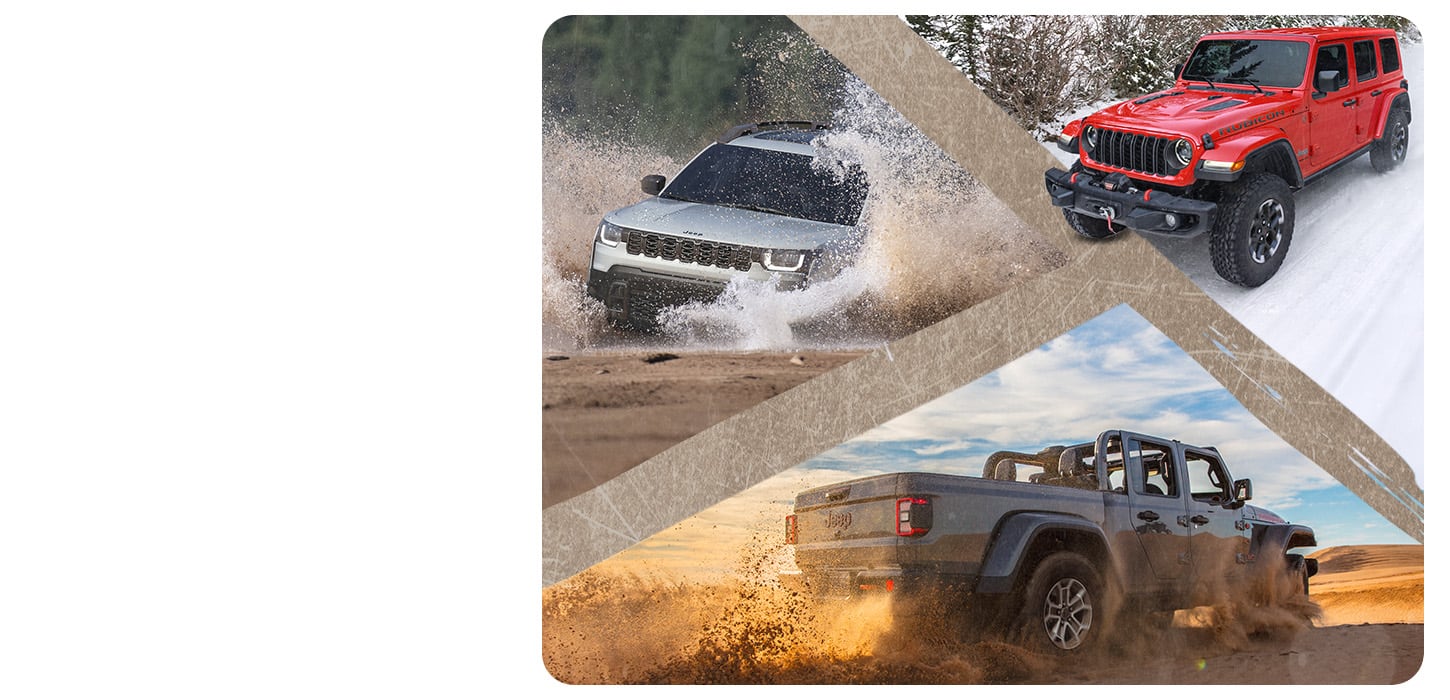 Do not attempt water fording unless depth is known and consistent with the vehicle’s water fording rating in the Owner’s Manual. Traversing water can cause damage that may not be covered by the new vehicle warranty. Always off road responsibly in approved areas. Jeep® Wrangler shown with aluminum hood. Actual hood may vary.
Off-Roading Techniques by Terrain
,Crossing a stream is a lot different than navigating rocks or rolling through sand. Here are a few different types of off-roading based on terrain, along with some driving techniques for each.
,
Two-Tracking
,Ever been skiing? Meet the bunny hill. Two-tracking is when you off-road down an unpaved but publicly-recognized path, usually with some wonderful wilderness on either side of you.
,Techniques – Get ready to handle some tight turns and pay close attention to posted signs about where you’re allowed to drive.
,Water Fording
,Admit it—when you imagine off-roading in a Jeep® Brand vehicle, you think of splashing through a mountain stream. Thankfully, the high air intake, protected electronics and special seals on the Jeep Brand lineup make our vehicles excellent for water fording. The Jeep Gladiator can withstand 31.5 inches of water, and the Wrangler can take 34 inches.
,Techniques – Tread lightly at the shallowest, narrowest water crossings. Keep up the pace of a swift walk to put a bow wave in front of you—it’ll help keep water out of your engine.
,Dune Bashing
,Dune bashing is when you blast through sandy environments like the desert or the beach. It’s incredibly thrilling, but it can also be difficult if you don’t drive responsibly. The expertly-engineered handling, ground clearance, durability and traction of Jeep® Brand 4x4 vehicles will help make you a sandstorm of one.
,Techniques – Don’t get distracted by how fun it is! Use your vehicle’s 4x4 capabilities and take a moment to breathe between whipping up a sand cloud.
,Rock Crawling
,Crawling over jagged rocks and mountain passes is what Jeep® Brand vehicles were made for. That said, that kind of terrain can be challenging, and it’s where all the off-roading equipment in your Jeep Brand vehicle is most helpful.
,Techniques – Slow, but steady. All of your vehicle’s articulation and durability are at work here. Hands on the wheel, keep it in a low gear, and don’t stomp on the brake. Reduce tire pressure once you’ve reached the trailhead to maximize traction.
,Snow Wheeling
,Snow wheeling is when you get to learn what your 4x4 vehicle is really made of in the winter months. Snow comes in different forms—there's powder, which is light and dusty; crusty snow, which mixes heavy snow with pieces of ice; and slush, which clings and clogs. Each presents its own set of pitfalls when off-roading.
,Techniques – Low gear, easy does it. On a snowy trail, speed can be your enemy, digging you further into the snow and ruining your traction. Keep it in 4-Low and take your time feeling out each new obstacle or change in terrain.
,Overlanding
,For some, the destination and the terrain come second to the journey itself. Overlanding has many definitions, but the running themes are long-form adventures where you live and camp out of your vehicle. You can overland in everything from a bicycle to a pickup truck, but spiritually this technique is about traveling for traveling’s sake—learning about new cultures, crossing borders and shifting terrain. Off-roading is usually an important part of overlanding, but it’s just one part of it.
,Techniques – The journey starts with your suitcase. If you’re driving for long periods of time, having what you need, from good snacks to the right soundtrack, can make or break a trip.
,
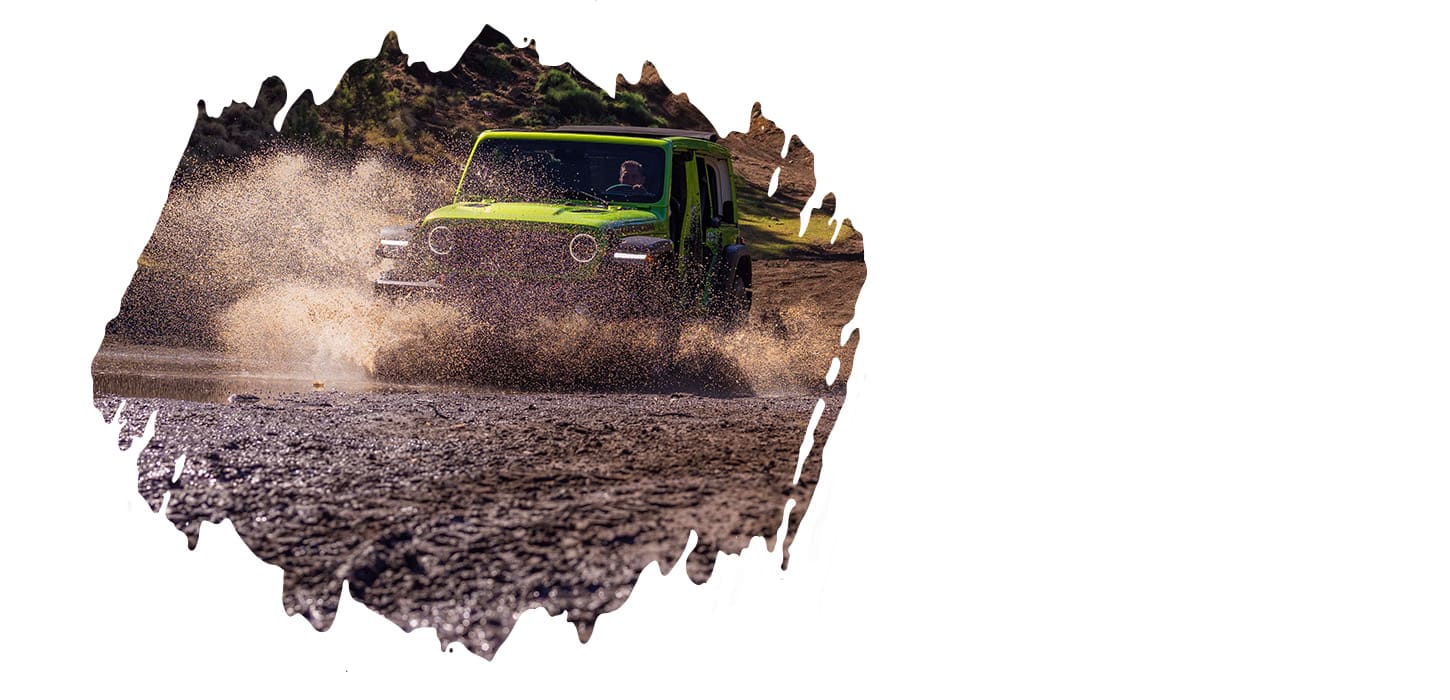 Jeep® Wrangler shown with aluminum hood. Actual hood may vary.
Mudding
,Basically, “mudding” is just… driving in the mud. Elaborate, right? As an activity, mudding has become a favorite of off-road 4x4 drivers because it gives them a chance to kick up mud, spin around a bunch and make a mess.
,That said, mudding has some practical applications, including:
,Escape practice – Getting stuck in your vehicle can make you panic. But mudding lets you explore different ways to get your vehicle out of the mud. This way, when an actual bad day hits you, you’ll be ready.
,Stealth – When you get mud all over your vehicle, it’s harder to see.
,Stress relief – Sometimes, you don’t want to drive. Sometimes, you just want to blast mud all over the damn woods.
,Techniques – Keep an eye on the terrain ahead and pack recovery gear. You don’t want to run into a half-submerged rock—and if you do, you want to be able to get out of there.
,
Towing and Towing Capacity
,When it comes to off-road driving, knowing how much you can tow is crucial, both for bringing large gear out into rough terrain and being able to tow large objects or other vehicles out of tricky situations. And if you want to bring along other types of off-roading vehicles—snowmobiles, dirt bikes or ATVs—towing is key.
,Thankfully, Jeep® Brand vehicles are built with towing in mind—the 2026 Jeep® Grand Wagoneer has a Best-in-Class available maximum towing capacity of 10,000 pounds, the 2026 Jeep Gladiator has Unsurpassed-in-Class maximum gas towing capacity of 7,700 pounds, the 2026 Jeep Grand Cherokee has a Best-in-Class maximum towing capacity of 6,200 pounds, the 2026 Jeep Wrangler Rubicon has a Best-in-Class available maximum towing capacity of 5,000 pounds, the 2026 Jeep Cherokee has an Unsurpassed-in-Class maximum towing capacity of 3,500 pounds, and the 2026 Jeep Compass has an Unsurpassed-in-Class maximum towing capacity of 2,000 pounds.
,
Trail Etiquette
,In the big, wild world, there are no rules… but there are some pretty common guidelines about how to treat your path and the other adventurers who might explore it. Here’s how to be respectful along the way.
,If there’s a trail, stay on it. If you’re forging a new path, great—but in a designated off-roading area, stay on the marked paths.
,Respect wildlife. If a bear came roaring into your home in a Jeep® Wrangler, you’d want him to respect you, too.
,Yield to hikers, cyclists and horses. You’re a big, tough 4x4 vehicle. Give them some room.
,If you pass other adventurers, let them know how many are in your party. This is important to make sure everyone passes safely. On off-road trails, this can often be done through hand signs and signals. For example, if you have four vehicles in your party, you can flash four fingers at another group to let them know.
,Keep the person behind you in your rearview mirror. If you’re off-roading as a group, keeping the vehicle behind you in sight helps to make sure no one gets lost.
,Clean up your trash. Leave no trace, especially in the form of a soda can or plastic bag.
,Keep your pet on a leash. Rock crawling isn’t as fun when you’re screaming, “BAXTER!” out of your window.
,Keep the music down. If someone came out this far, they probably don’t want to hear about how life is a highway.
,For more information about safe and responsible off-roading, check out Tread Lightly, a nonprofit organization focused on teaching the art of smart and responsible off-roading.
,
Conquer Trails with Jeep® Badge of Honor®
,Want to map out your next off-roading adventure, earn digital badges and meet like-minded adventurers? Jeep® Badge of Honor® is an online community where 4x4 diehards can explore trails, set challenges for themselves and even compete with other 4x4 drivers!
,
Getting to Know Your Jeep® Brand 4x4 Vehicle
,With terms and techniques under your belt, it’s time to understand how your Jeep® Brand 4x4 vehicle offers you the off-roading capability you need, as well as preparations, modifications and accessories that might help you along the way. Read our article exploring your Jeep Brand 4x4 vehicle now and learn about everything from all-terrain tires to suspension systems and locking differentials.
,
Time to Take Things Off-Road!
,Now that you can talk the talk, it’s time to walk the walk (or drive the drive, anyhow). Whether you’re chatting breakover angles or planning a day of dune bashing, the knowledge from this article is a good foundation for a fantastic off-roading experience. Whatever you call it, wherever you do it—enjoy the ride!
,
Climb In and Take Off,Ready to choose a Jeep® Brand vehicle to take you where the pavement ends? Explore your options below.
,
Jeep® Recon
Jeep® Grand Cherokee
Jeep® Grand Wagoneer
Found this article helpful?
,Share it online and help other drivers on their next off-roading adventure!
,
- Jeep Wrangler shown with aluminum hood. Actual hood may vary.
Get Ready with Jeep® Brand Performance Parts from Mopar®
,The Mopar® eStore has the Jeep® Brand Performance Parts needed to customize your off-roading experience.
,
Related Topics,Want to learn more? Check out some other articles from the Jeep® Brand.
,