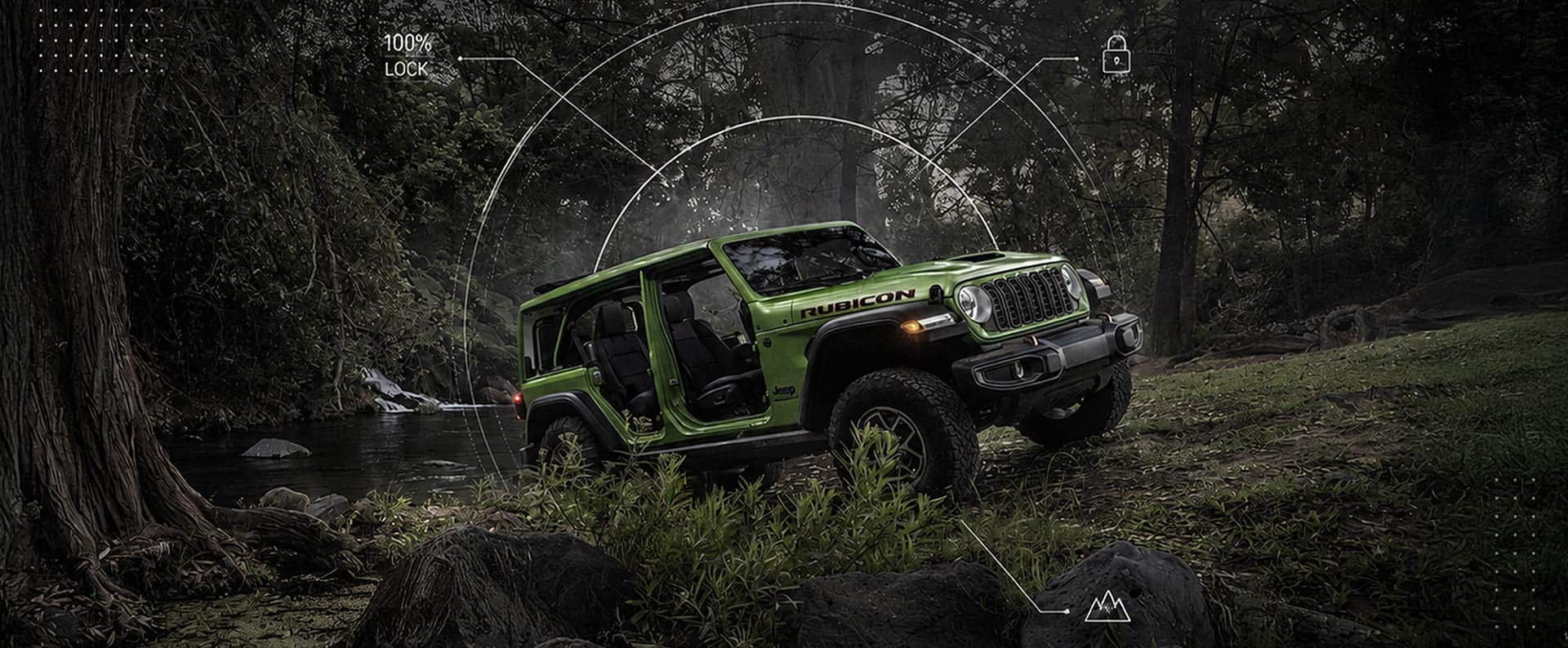

What lockers are, how they work and why they’re important for off-roading
If you’re getting into off-roading, you’ve probably heard the phrase “locking differentials” or “front or rear lockers” … but what exactly are they? And what do they do? We’ll dive in and give you some tips about how to find the right ones for your vehicle, too.
Right, the whole point of the article: Locking differentials (sometimes called lockers) are devices that lock both wheels on an axle to turn at the same speed, boosting traction on uneven or slippery terrain. They’re one of the biggest force multipliers in off‑road traction. When terrain lifts one tire or buries it in mud, a locker keeps both wheels on the same axle turning together so the wheel with grip can pull you through. That simple idea is a cornerstone of Jeep® Brand capability and key when it comes to rock crawling, mudding or extreme off-roading.
A differential sits between the ring and pinion gears and the axle shafts. When it’s NOT locked (aka an “open differential”) spider gears inside the differential carrier allow left and right wheels to rotate at different speeds for smooth turning on pavement.
A locking differential temporarily disables that speed difference and couples both sides together. Locking differentials lock both wheels on an axle to turn at the same speed. There are different types of locking differentials, too:
Mechanical/Automatic Lockers
Selectable (Driver-Controlled) Lockers
So why are locking differentials important for off-roading? Without a locking differential, on rocks, sand or other slippery terrain, one wheel would just spin while the other would sit still. By locking power to both wheels, you can help get confident climbing, controlled descents and fewer rescues.
On uneven ledges, ruts or loose climbs, lockers maximize torque distribution so momentum isn’t required—you can crawl slowly with more control and less wheelspin. In deep snow or sand, a rear differential lock helps you stay on top of the surface, while a front differential lock adds pull when the front tires start to hit obstacles.
Only use lockers on slippery ground, and switch them off before tight turns on dry pavement so the wheels can turn freely and the vehicle doesn’t plow straight ahead.
A Limited-Slip Differential (LSD) biases torque toward the tire with more traction but still allows some speed difference between wheels. It’s excellent for mixed use—rain, gravel, light trails—and feels natural on-road. A true locker provides a 100% lock, forcing equal wheel speed for maximum traction in extreme terrain.
Trail Rated® means a vehicle is highly capable in five areas: traction, water fording, articulation, ground clearance and maneuverability. Locking differentials fall into the traction and articulation pillars by helping power reach the ground even when a wheel lifts. The Jeep® Brand integrates selectable front and rear lockers on advanced off‑road trims for certain models, like Jeep Wrangler, Jeep Gladiator and Jeep Recon , which makes them great for technical terrain. Get to know your off-road vehicle.
So when it’s all said and done, locking differentials turn wheelspin into forward progress. As a core element of our off‑road story—and a factor of Trail Rated® capability—lockers can be the difference between trying a trail and conquering it. Learn more tricks of the trail at Jeep® Brand 101.
Several Jeep® Brand vehicles have advanced locking differential options. Check them all out and find the right one for you.
Share it online and help other drivers on their next off-roading adventure!
From trailer hitch add-ons to electrical equipment, the Mopar® eStore has the Jeep® Brand Performance Parts needed to customize your off-roading experience.
Want to learn more? Check out some other articles from the Jeep® Brand.
VEHICLES
COST
RESEARCH
LOCATE
CAPABILITY
Electrification